
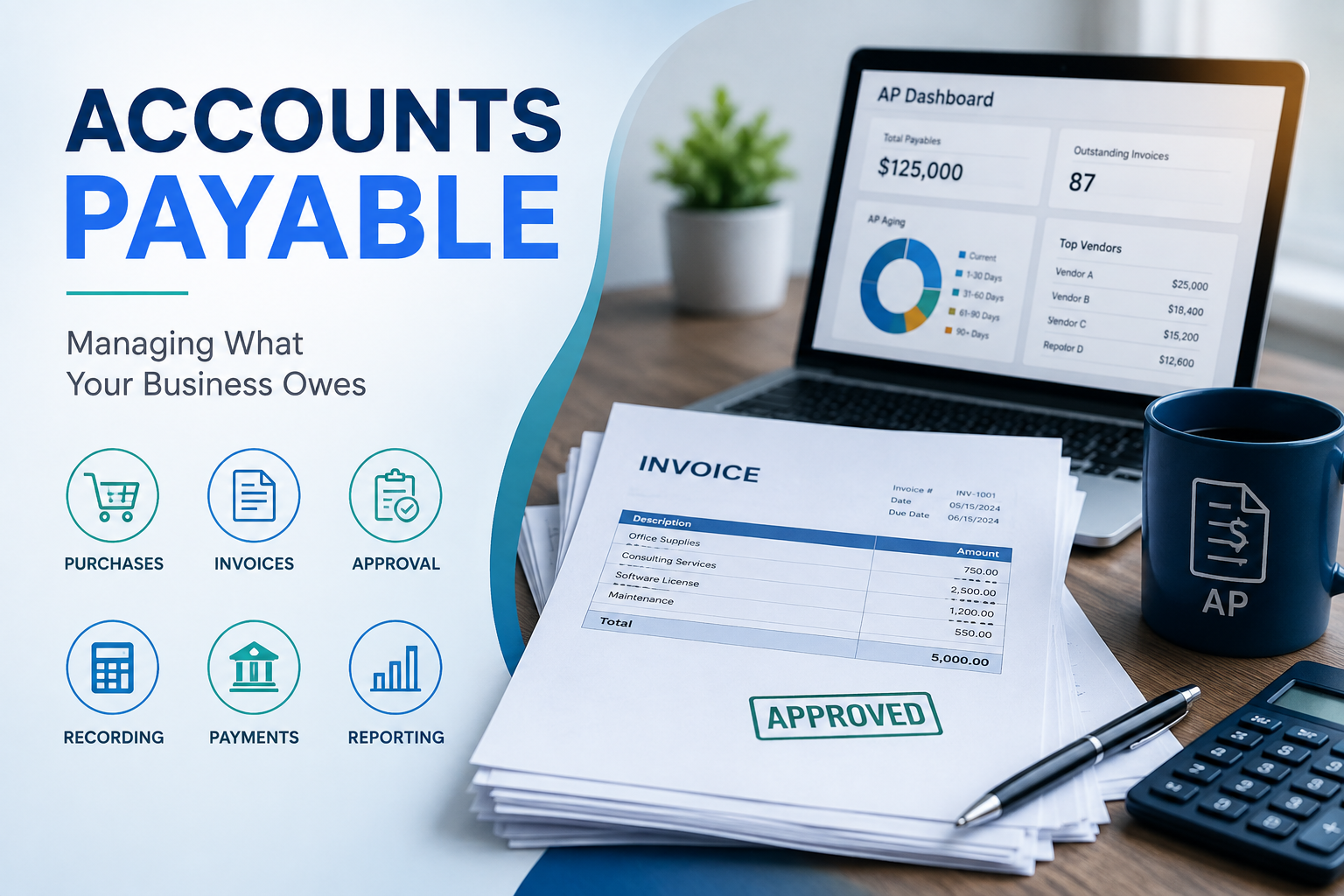
Accounts Payable, commonly known as AP, is a core financial function that manages the money a business owes to suppliers and vendors. It begins when goods or services are purchased on credit and continues through invoice receipt, verification, approval, recording, payment, and reconciliation.
From an accounting perspective, accounts payable is recorded as a current liability because it represents short-term financial obligations that the business is expected to settle within an agreed period.
What Is Accounts Payable?
Accounts payable (AP) is the money a business owes to suppliers, vendors, contractors, or other creditors for goods and services received but not yet paid for. Accounts payable is generally recorded as a current liability on the balance sheet because these obligations are usually expected to be paid within a relatively short period.
For example, if a company purchases $10,000 of materials from a supplier with payment due in 30 days, the $10,000 remains in accounts payable until the supplier is paid.
However, the accounts payable meaning goes beyond the amount shown on the balance sheet.
Accounts payable also refers to the business function responsible for managing supplier invoices, verifying charges, obtaining approvals, recording liabilities, scheduling payments, reconciling supplier accounts, and maintaining accurate payment records.
In simple terms:
Purchase → Invoice → Verification → Approval → Accounts Payable → Payment → Reconciliation
Understanding what accounts payable is is important because AP directly affects cash flow, supplier relationships, working capital, financial reporting, and internal financial controls.
Accounts Payable Definition
A simple accounts payable definition is:
Accounts payable represents amounts a company currently owes its suppliers or vendors for goods or services purchased on credit.
A business creates an accounts payable obligation when it receives goods or services before making payment.
Consider a company purchasing office equipment for $8,000.
If the company pays immediately, there may be no outstanding accounts payable balance related to that transaction.
If the supplier provides 30-day payment terms, however, the company records an $8,000 liability until payment is made.
Therefore:
Immediate payment = No outstanding AP
Purchase on credit = Accounts payable created
Supplier payment = Accounts payable cleared
This distinction is fundamental to understanding AP accounting.
What Does AP Mean in Accounting?
AP stands for Accounts Payable.
In accounting, AP represents short-term amounts owed by a company to its suppliers and other creditors.
Accounts payable is commonly associated with purchases such as:
- Raw materials
- Inventory
- Equipment
- Office supplies
- Professional services
- Utilities
- Subcontractor services
- Maintenance services
- Technology services
- Other business expenses
The exact accounting treatment depends on what the company purchased.
For example, purchasing inventory may affect an inventory account, while receiving consulting services may create an expense.
In both cases, if payment is deferred, the amount owed can create an accounts payable liability.
How Does Accounts Payable Work?
To understand how accounts payable works, consider a simple supplier transaction.
A manufacturing company orders $25,000 of raw materials from a supplier.
The supplier delivers the materials and issues an invoice with Net 30 payment terms.
The company now has an obligation to pay $25,000.
Step 1: Goods are received
The company receives the materials.
Step 2: Supplier sends the invoice
The invoice specifies:
- Invoice number
- Supplier
- Purchase details
- Amount
- Taxes
- Payment terms
- Due date
Step 3: Invoice is verified
The company checks whether the invoice agrees with its purchasing and receiving records.
Step 4: Invoice is approved
The appropriate manager or department authorizes the invoice for payment.
Step 5: Liability is recorded
The $25,000 becomes part of the company’s accounts payable balance.
Step 6: Payment is scheduled
The company schedules the invoice according to its payment terms.
Step 7: Supplier is paid
Once the $25,000 payment is processed, the corresponding accounts payable balance is reduced.
This sequence forms part of the broader accounts payable process.
Related Guide: Accounts Payable Process →
Accounts Payable Example
Let’s look at another simple example.
ABC Construction purchases $50,000 of building materials from XYZ Supplies.
The supplier offers Net 30 payment terms.
This means ABC Construction receives the materials today but can pay the $50,000 invoice within 30 days.
Until ABC Construction pays XYZ Supplies:
Accounts Payable = $50,000
When the invoice is paid:
Accounts Payable related to that invoice = $0
The transaction therefore moves through three basic stages:
Purchase on Credit → Outstanding Liability → Payment
This is the fundamental concept behind accounts payable.
Where Does Accounts Payable Appear on the Balance Sheet?
Accounts payable normally appears in the current liabilities section of the balance sheet.
Current liabilities are financial obligations generally expected to be settled within the company’s normal operating cycle or within a relatively short period.
For example:
| Current Liabilities | Amount |
|---|---|
| Accounts Payable | $125,000 |
| Accrued Expenses | $35,000 |
| Payroll Liabilities | $40,000 |
| Short-Term Debt | $75,000 |
| Total Current Liabilities | $275,000 |
Here, the $125,000 accounts payable balance represents outstanding supplier obligations recorded by the company.
Because AP affects current liabilities, maintaining accurate accounts payable records is important for reliable financial reporting.
Is Accounts Payable an Asset or a Liability?
Accounts payable is a liability, not an asset.
The distinction is straightforward:
Assets represent economic resources controlled by the business.
Liabilities represent financial obligations the business owes to others.
Since accounts payable represents money owed to suppliers, it is classified as a liability.
In most situations, it is specifically classified as a current liability.
Is Accounts Payable a Debit or Credit?
Accounts payable normally has a credit balance.
When a company records an invoice from a supplier, accounts payable generally increases with a credit.
Suppose a company purchases $5,000 of office supplies on credit.
The accounting entry could be:
| Account | Debit | Credit |
| Office Supplies Expense | $5,000 | — |
| Accounts Payable | — | $5,000 |
The credit increases the accounts payable liability.
When the company pays the supplier:
| Account | Debit | Credit |
| Accounts Payable | $5,000 | — |
| Cash/Bank | — | $5,000 |
The debit reduces the outstanding AP liability.
A simple way to remember this is:
Supplier invoice recorded → Credit AP
Supplier invoice paid → Debit AP
For a deeper explanation, see:
Related Guide: Is Accounts Payable a Debit or Credit? →